
How a Foreign National Can Obtain 'Representing an Interest' Status in Russia
Russia's new mechanism for recognising foreign nationals as representing an interest to the Russian Federation, setting out eligibility criteria, application procedure, and the privileges it confers. A detailed legal overview.


Russia has introduced a new mechanism to support the resettlement of foreign nationals who may be of value to the country. The relevant Presidential Decree No. 883 was signed on 2 December 2025. The document entered into force immediately upon publication, but became operational only later – on 15 April 2026, when the Ministry of Justice registered Order No. 202 of the Ministry of Internal Affairs (MVD), which approved all application forms and procedures. From that date, foreign nationals acquired the right to submit petitions for recognition as persons representing an interest for Russia.


Presidential Decree of the Russian Federation No. 883 of 2 December 2025 'On Supporting the Resettlement to the Russian Federation of Foreign Nationals and Stateless Persons Representing an Interest for the Russian Federation...' // Official Internet Portal of Legal Information


Order of the Ministry of Internal Affairs No. 202 of 10 April 2026 'On the Organisation of Work on the Recognition of Foreign Nationals and Stateless Persons as Representing an Interest for the Russian Federation' // Official Internet Portal of Legal Information
The new mechanism is built on entirely different principles from the previous system. Under the standard procedure for obtaining a temporary residence permit or permanent residence permit, a foreign national is expected to already be in Russia, to work through a series of bureaucratic steps, to pass a Russian language examination, to obtain medical certificates, and to wait for a quota allocation. That approach requires the individual to adapt to the system. Presidential Decree No. 883 inverts this logic: the state assumes a proactive stance towards the foreign national. It is the state itself that has an interest in a particular individual relocating to Russia on a permanent basis, and it creates an accelerated and simplified pathway to that end.
The mechanism is founded on the concept of the organic integration of the foreign national into the system of positive social ties within Russian society – the precise formulation used in the Regulations approved by the same Decree. What does this mean in practice? Scientists, athletes, cultural figures, industrial professionals, holders of scarce specialisations, and those who have already rendered tangible assistance to Russia. For each of these categories, the Regulations establish detailed criteria.
The new instrument fits into a broader trend of recent years – the creation of dedicated legal regimes for foreign nationals who are of heightened interest to the state. The Highly Qualified Specialist (HQS) status and the special naturalisation procedure under Article 17 of the Citizenship Act follow the same logic, and the new 'representing an interest' status follows the same underlying principle. In terms of the categories it covers, it is broader than the familiar HQS framework, while the privileges it confers – a simplified procedure for obtaining a temporary and permanent residence permit – make it a highly attractive instrument.
Who May Submit a Petition
The Regulations on the procedure for recognising foreign nationals as representing an interest for the Russian Federation identify seven independent grounds. Satisfying at least one of them is sufficient to submit a petition. Each is examined in detail below.
Scientific and Technological Development
This is the most detailed category. A foreign national may seek recognition on this ground if they are a foreign member of the Russian Academy of Sciences, a laureate of the Lomonosov Grand Gold Medal, or hold a patent for an invention protected in Russia or under an international treaty. The category also covers holders of a Russian candidate of sciences or doctoral degree, or a foreign degree recognised in Russia, as well as laureates of an international prize in science and technology from the Government-approved list.

For the Government-approved list, see Government Resolution No. 89 of 6 February 2001, as amended on 4 March 2026 (Legal Reference System 'ConsultantPlus').
A separate provision covers researchers already employed at Russian state scientific or educational institutions who hold a recommendation from such an institution. This is a significant nuance: for current employees of Russian institutes or universities, the path to recognition is shorter – a letter of support from the employer is sufficient.
Practical example: a German physicist holding a doctoral degree recognised in Russia and an invitation from a state research centre to work for at least one year falls squarely within this category.
Industry and Production
For entrepreneurs and industrialists, the Regulations establish a more concrete economic criterion. The foreign national must be a founder of a small or medium-sized enterprise with annual revenue of no less than 10 million roubles, and the company's activities must fall within one of the priority sectors under the national classification of economic activities: manufacturing, hospitality and food service, information and communications, or professional and scientific-technical activities.
Alongside this formal criterion, a general ground is provided for documented achievements in the field of production that demonstrate a high potential for organic integration into the system of positive social ties in Russian society. This provision gives the MVD and the operator some of flexibility in assessing non-standard cases.
Practical example: a Turkish entrepreneur who owns a metalworking manufacturing enterprise in Russia with annual revenues exceeding 10 million roubles meets this ground.
Sport
The sports category covers towards elite athletes. The criteria here are formal and readily verifiable: champions or medallists of the Olympic, Paralympic, Deaflympics, or World Special Olympic Games, World and European Championships; winners or medallists of the CIS Games or the BRICS Sports Games; and holders of the Russian title of Master of Sport of International Class or Grandmaster of Russia.
A separate provision covers winners and medallists of professional international competitions listed in the Unified Calendar Plan, where accompanied by an invitation from a Russian professional club or training centre and a commitment to work with it for at least one year.
Practical example: a Brazilian footballer who has represented the national team and received an invitation from a Russian professional club meets this category on multiple grounds.
Creative Industries and Cultural Affairs
This category encompasses foreign members of the Russian Academy of Arts, laureates of international prizes in culture, literature, and the arts from the Government-approved list, and employees of Russian state cultural organisations holding positions from a special list of creative professions.
Notably, the same category also covers qualified specialists in clothing and accessories design, visual design, architecture, urban planning, gastronomy, information and telecommunications technologies, public relations, and gallery management – where accompanied by documented achievements. The category is accordingly considerably broader than the conventional notion of a 'cultural figure' and extends to representatives of contemporary creative industries.
Practical example: an Italian architect with an international portfolio, invited by a Russian state developer for a large urban development project, may seek recognition on this ground.
Academic Achievement
The education category rewards academic merit. It covers winners and medallists of international subject olympiads from the Government-approved list who have received an invitation to study at a Russian state educational institution, as well as graduates of universities ranked in the top 20 of the Academic Ranking of World Universities, QS, or Times Higher Education world rankings.
For graduates of top-100 universities in those same rankings, an additional condition applies: the average grade across examinations must be no less than 75% of the maximum possible score. This condition distinguishes the highest-performing graduates – it is these top-performing graduates, rather than any graduate of a highly ranked university, who qualify for recognition.
Practical example: an MIT graduate with an A average who wishes to pursue a career in Russia meets the criteria for this category without any additional requirements.
Contribution to Social, Economic, and Security Development
This is the seventh category by numbering in the Regulations, but one of the most substantively significant. A foreign national may be recognised on this ground if they hold a state award of the Russian Federation or the highest departmental distinction of a public authority for services rendered in the relevant field, or if they satisfy the criteria for obtaining a permanent residence permit on investment grounds as established by the Government.
This ground is directed at those who have already delivered tangible benefit to Russia and can document it accordingly.
Professions in High Demand
The final category is strictly practical in nature and labour-market focused. It covers foreign nationals whose profession appears on the Ministry of Labour's list of specialisations conferring the right to obtain a permanent residence permit without a prior temporary residence permit, provided they have at least five years of confirmed experience in that profession.


Order of the Ministry of Labour and Social Protection of the Russian Federation No. 172n of 3 April 2025 'On Approval of the List of Professions (Specialities, Positions) of Foreign Nationals and Stateless Persons – Qualified Specialists Entitled to Obtain a Residence Permit in the Russian Federation Without Obtaining a Temporary Residence Permit' // Official Internet Portal of Legal Information
A broader sub-category is also provided: specialists in manufacturing and extractive industries, transport, tourism, construction, communications, IT, education, healthcare, agriculture, and environmental management – provided they hold a relevant higher education qualification and at least five years of confirmed experience.


Directory of in-demand, new and promising professions // Rabota Rossii, the national database of vacancies and CVs.
Practical example: a Chinese software engineer with 10 years of experience and a technical university degree who wishes to relocate to Russia to work for an IT company falls within this category, subject to inclusion in the list of in-demand professions.
Step-by-Step Procedure
The mechanism for recognising a foreign national as representing an interest for the Russian Federation operates as a multi-tiered administrative chain involving four actors: the foreign national, an authorised non-profit operator organisation, the MVD, and the Resettlement Working Group under the Presidential Commission on Citizenship. Each stage is examined in sequence below.
Step 1. Contacting the Operator
The procedure begins with the authorised non-profit operator organisation, which was established by the Autonomous Non-Profit Organisation 'Agency for Strategic Initiatives to Promote New Projects' (ASI). It is to the operator that the foreign national submits their petition for recognition as representing an interest for the Russian Federation.
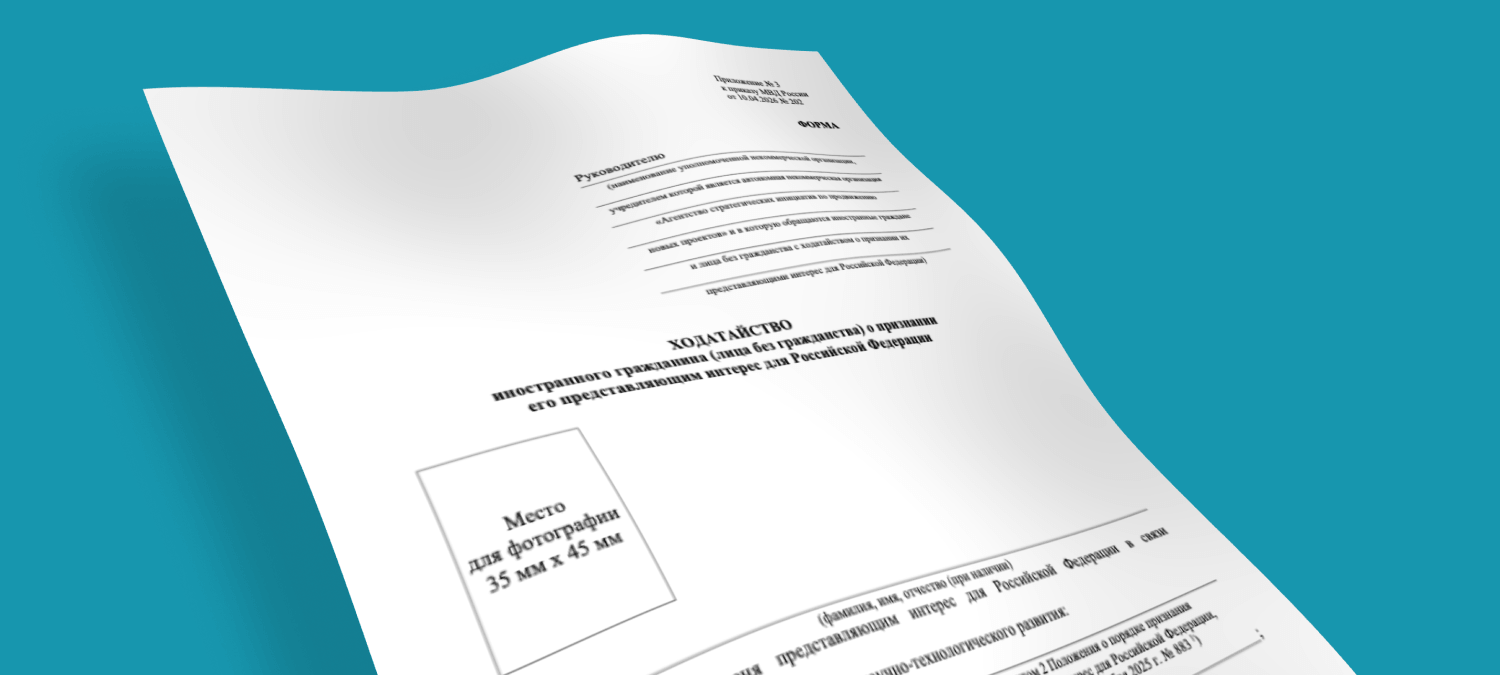
The petition must be completed in Russian, legibly, in block letters, either by hand or using technical means, without corrections or abbreviations. The form approved by MVD Order No. 202 includes standard biographical information:
- identity document details;
- citizenship;
- marital status;
- education;
- qualifications;
- employment history over the preceding five years;
- information on criminal convictions and administrative penalties.
In addition, the petition sets out the applicant's reasons for applying and confirms their respect for traditional Russian spiritual and moral values and their wish to relocate to Russia on a permanent basis.
The petition must be accompanied by a certified copy of the identity document, documents confirming the applicant's compliance with one or more of the criteria set out in the Regulations, and a brief curriculum vitae.
The petition may be submitted either by the foreign national personally or – with their consent – by a federal state body, the senior official of a constituent entity of the Russian Federation, a member of the State Duma, a senator, or the head of a state corporation.
Step 2. Expert Assessment by the Operator
Following receipt of the documents, the operator carries out a comprehensive expert assessment of the foreign national's personal qualities and merits. The purpose of the assessment is to establish whether the applicant genuinely meets one or more of the criteria in the Regulations and has the potential for organic integration into the Russian society.
The standard assessment period is 30 days from the date the petition is received. For certain grounds where compliance is self-evident from formal documents – such as foreign members of the Russian Academy of Sciences, Olympic champions, or international olympiad winners – the period is reduced to 15 days.
Where the operator concludes that the applicant meets the criteria of the Regulations, it transmits to the MVD Migration Service – no later than the following business day after the completion of the assessment – a recommendation that the foreign national be recognised as representing an interest for the Russian Federation. The recommendation is accompanied by the petition, all applicant documents, and materials substantiating the recommendation. The form of the recommendation is also approved by MVD Order No. 202.
Where the operator determines that the applicant does not meet the criteria, it notifies the foreign national accordingly. The applicant's documents are retained by the operator for one year, during which the applicant may request in writing the return of the original documents.
Step 3. MVD Verification
Upon receiving the operator's recommendation, the MVD Migration Service organises a verification check regarding the foreign national no later than the following business day. The check is conducted across several areas simultaneously.
Internal police records are queried to establish the presence or absence of criminal proceedings, convictions, or inclusion in a federal or international wanted list. The state migration registration information system is checked for details of previously issued temporary and permanent residence permits, deportation orders, administrative removal decisions, declarations of undesirability, and entry bans. A separate request is submitted to the Federal Security Service (FSB) for information that may indicate grounds for refusing a temporary or permanent residence permit.
Federal bodies that receive a request from the MVD are required to respond within 30 days. Where clarification of circumstances is required, that period may be extended by a further 30 days.
Where the foreign national already holds a valid temporary or permanent residence permit, requests to other agencies may not be necessary – the MVD may conduct the verification independently using its existing records and then forward the materials to the Working Group.
Step 4. The Resettlement Working Group
Where the verification reveals no grounds for refusal, the MVD forwards a recommendation, together with the supporting materials and verification findings, to the Resettlement Working Group – a dedicated body established under the Presidential Commission on Citizenship of the Russian Federation.
The Working Group considers the materials within 30 working days. Where it has no objections, the procedure advances to its final stage. Where objections are raised, the chairman of the Working Group notifies the MVD, which then prepares a decision on refusal.
Step 5. MVD Decision
The MVD issues its decision on recognition 40 working days after forwarding the materials to the Working Group – provided no objections have been received from it. The decision is certified with the seal bearing the State Emblem of the Russian Federation.
Within three working days of the decision, the MVD transmits notification to the foreign national and to the operator. Where technically feasible, the notification is delivered to the applicant's personal account on the Gosuslugi portal.
The document confirming recognition is this MVD letter itself. From the moment it is received, the foreign national is entitled to apply for a temporary or permanent residence permit under the special procedure. Crucially, the individual has exactly one year in which to exercise this right.
Where at any stage it emerges that the applicant does not meet the criteria of the Regulations, or that lawful grounds exist for refusing a temporary or permanent residence permit, the MVD issues a decision on refusal. This is also issued in writing and transmitted to the applicant within the same three-day period.
What the Status Confers
Recognition as a person representing an interest for the Russian Federation opens access to a set of privileges, each of which is significant in its own right and which together constitute a fundamentally different legal regime compared with standard immigration procedures.
Temporary Residence Permit Without a Quota or Language Examination
The primary barrier in the standard temporary residence permit procedure is the quota. The Government sets annual regional limits, and demand routinely exceeds supply. A foreign national recognised as representing an interest submits an application for a temporary residence permit outside the quota – meaning that neither the timing of the application nor the region of residence affects the applicant's chances on formal grounds.
The second removed barrier is the language examination. Under the general rule, an applicant for a temporary residence permit must demonstrate proficiency in Russian and knowledge of Russian history and the fundamentals of Russian law. This requirement does not apply to those recognised as representing an interest.
The processing time for a temporary residence permit application is also reduced: rather than the standard six months, the MVD is required to issue a decision within 30 days.
Permanent Residence Permit Without Prior Temporary Residence
Under standard Russian immigration law, a permanent residence permit follows a temporary residence permit: first a temporary permit, then – as a rule, no earlier than one year later – a permanent permit. For a foreign national recognised as representing an interest, this sequence is not mandatory. They are entitled to apply directly for a permanent residence permit, bypassing the temporary residence stage. This substantially shortens the overall timeline and enables the individual to secure long-term status in Russia more rapidly.
Employment Without Work Authorisation Documents
Foreign nationals are, with limited exceptions, required to obtain a work permit or work patent to engage in employment in Russia, while employers must obtain a permit to attract and use foreign labour. For a foreign national recognised as representing an interest, and for their family members, this requirement is waived.
An important detail: the right to work without authorisation documents arises not from the moment of recognition, but earlier – from the moment an application for a temporary or permanent residence permit is submitted – and remains in effect until a decision on that application is issued. The foreign national may therefore commence employment without waiting for the residence application to be decided.
A condition is that the employer must notify the territorial body of the MVD of the conclusion of an employment or civil law contract within three working days of its conclusion.
Status Extends to Family Members
All of the privileges described above extend not only to the foreign national themselves, but also to their family members. The Regulations define this circle broadly: a spouse, parents and adoptive parents, children – including adopted children and those under guardianship – and the children of the spouse on the same terms.
Family members are entitled to apply for a temporary or permanent residence permit under the same special procedure. Their status is, however, derivative of the principal applicant's: if the temporary or permanent residence permit issued to the foreign national recognised as representing an interest is cancelled, the corresponding documents of their family members obtained on the same basis are cancelled as well.
Operator Assistance
Following a positive decision, the operator provides the foreign national, free of charge, with assistance in preparing and submitting the documents required to obtain a temporary or permanent residence permit. The operator may also assist with practical matters arising in connection with the move to Russia, including finding accommodation and employment.
This support does not constitute a mandatory service with a guaranteed scope, but its availability is an advantage that distinguishes this mechanism from standard immigration procedures, where the foreign national is left entirely to their own devices.
Multiple-Entry Business Visa
A separate provision allows a foreign national who already holds a confirming document to obtain an ordinary multiple-entry business visa for a period of up to one year. In exceptional circumstances, the visa is issued upon a written application by decision of the head of a Russian diplomatic mission or consular post.
This enables the foreign national to enter Russia and begin the process of obtaining a temporary or permanent residence permit even where they would not otherwise qualify for entry under the standard visa rules.
Comparison with Naturalisation in Exceptional Circumstances
The 'representing an interest' status and naturalisation in exceptional circumstances under Article 17 of the Citizenship Act address a similar objective – the accelerated integration of a valuable foreign national into the Russian legal system. They are, however, fundamentally different instruments with different entry thresholds, different outcomes, and are based on different underlying rationales. Understanding this distinction is essential when choosing the optimal route.
The Essence of the Exceptional Naturalisation Procedure
Article 17 of the Citizenship Act provides that the President of the Russian Federation may decide to grant citizenship to a foreign national who has rendered special services to Russia or whose admission to citizenship is of state interest. The law establishes no formalised criteria – the decision is made by the President upon a submission from a federal executive authority or the senior official of a constituent entity. This means that the exceptional procedure is purely discretionary: there are no guaranteed grounds, no mandatory timelines, and no formalised procedure available to the applicant.
The requirements imposed on the applicant are considerably more relaxed than under the general procedure: there is no requirement to confirm five years of permanent residence in Russia, no language examination, no financial threshold, and – unless the President's decision provides otherwise – no requirement to renounce another citizenship. The result is full Russian citizenship, not an intermediate immigration status.
Key Differences
The first and most important distinction is legal certainty. The 'representing an interest' mechanism is built on formalised criteria. The Regulations contain an exhaustive list of grounds, specific benchmarks, and defined timelines. An applicant can assess in advance whether they meet the requirements and form a realistic view of their prospects. Exceptional naturalisation offers no such certainty – the assessment of state interest is made at the highest political level and cannot be predicted by reference to formal criteria.
The second distinction is the ultimate legal outcome. Recognition as representing an interest provides accelerated access to a temporary or permanent residence permit – the status of a permanently residing foreign national. Citizenship acquired in exceptional circumstances means a full Russian passport with all attendant rights and obligations, including military service obligations for eligible men.
The third distinction is initiative. A petition for recognition as representing an interest is submitted by the foreign national themselves. Exceptional naturalisation is generally initiated from above: the submission must come from a federal executive body or the senior official of a constituent entity, although in practice such a submission may be prepared at the foreign national's request and with their active involvement.
The fourth distinction is predictability of timelines. The recognition procedure has a clearly defined schedule: operator assessment – 30 days; MVD verification – up to 60 days; Working Group review – 30 working days; final MVD decision – 40 working days. In total, the procedure takes approximately four to five months in the absence of complications. The timelines for consideration of exceptional naturalisation applications are not regulated by law.
When It Makes Sense to Apply Directly for Citizenship
The exceptional naturalisation route is worth considering primarily where the foreign national's contribution to Russia's interests is manifest, publicly acknowledged, or documented at the state level. If the individual already holds Russian state awards, if their activities have been formally recognised by a competent federal ministry, or if a senior official is prepared to speak in their support, then the exceptional procedure is a realistic option.
The exceptional route is also preferable where the foreign national is unwilling to remain in an intermediate immigration status and is seeking maximum legal certainty in the shortest possible timeframe – provided the necessary political support is in place.
When the "Representing an Interest" Mechanism Is the Better Starting Point
Where a foreign national meets the formal criteria of the Regulations but does not have state recognition at the highest level behind them, the 'representing an interest' mechanism is the more predictable and manageable route. It requires no political support, rests on verifiable documentary criteria, and delivers a concrete legal outcome within a foreseeable timeframe.
The two paths are not mutually exclusive. A foreign national who obtains 'representing an interest' status and is issued a permanent residence permit continues to accumulate a history of residence in Russia and to build connections with state structures and the professional community – which may in turn create the conditions for a subsequent application for citizenship, whether in the exceptional procedure or in the general order once the relevant grounds arise.
Practical Guidance
The mechanism for recognising foreign nationals as representing an interest for the Russian Federation has been in active operation since April 2026. Practical application is still taking shape, and it is not yet possible to anticipate all potential pitfalls. Nevertheless, analysis of the Regulations and MVD Order No. 202 identifies a number of critical points that will determine the quality of any application.
Do Not Confuse Meeting a Criterion with Proving It
The most common mistake at the preparation stage is the applicant's conviction that they 'obviously' satisfy a particular criterion in the absence of the requisite documents. The Regulations and the MVD Order consistently use the formulation 'documented achievements'. This is not rhetorical – it is a requirement as to the evidential basis. When receiving the petition, the operator, verifies not only the presence of documents but also their correspondence to the information stated in the petition. Discrepancies will result in the documents being returned to the applicant.
The practical implication is that, before submitting a petition, the applicant must carry out a rigorous audit of their available documents and honestly assess which ones actually establish compliance with the claimed criterion. If the documentary foundation is weak, it must be strengthened before the petition is filed.
Choose the Right Ground
The Regulations permit the simultaneous citation of multiple grounds, and it is sensible to use this where appropriate. However, there is no value in listing every possible category in the hope that at least one will succeed. The operator conducts an expert assessment, and a petition with a diffuse position makes a worse impression than an application with one or two clearly reasoned grounds and convincing documentary support for each.
The primary criterion should be selected on the basis of two factors: the strength of the available documentary evidence, and the degree to which the assessment is objective rather than subjective.
Pay Particular Attention to the Statement of Motivation
The petition contains a mandatory section in which the applicant sets out their reasons for applying and confirms their respect for traditional Russian spiritual and moral values and their intention to relocate to Russia on a permanent basis. In most immigration applications, this section is completed formulaically with a couple of generic sentences. Experience suggests that replacing generic phrases with concrete facts is well worth the effort.
The motivation section is the only place in the petition where the applicant speaks in their own words. When conducting its assessment, the operator evaluates not only credentials but also the individual's potential for organic integration into Russian society.
Legalisation and Translation of Documents
Foreign documents issued abroad must, as a general rule, be legalised or apostilled – depending on whether the country of issue is a party to the Hague Convention. Exceptions are provided only under international treaties to which the Russian Federation is a party. Failure to comply with this requirement is a ground for the return of the documents.
Translation of documents into Russian may, at the applicant's request, be arranged by the operator – but this should not be relied upon. Time spent on translation is not included in the expert assessment period and automatically lengthens the overall procedure. It is preferable to submit documents accompanied by a notarised translation already prepared.
Bear in Mind the One-Year Deadline
Receiving the confirming document is not the end point – it is the start of the countdown. From the moment of receipt of the MVD recognition letter, the foreign national has exactly one year in which to submit an application for a temporary or permanent residence permit. If this deadline is missed, the recognition decision is revoked automatically and the document becomes invalid. A fresh application is possible, but it means going through the entire procedure again from the beginning.
Take Account of the Derivative Nature of Family Members' Status
Where a foreign national intends to obtain a temporary or permanent residence permit for family members, it must be borne in mind that their status is entirely derivative of the applicant's own. Cancellation of the principal applicant's temporary or permanent residence permit automatically entails the cancellation of the corresponding documents of family members obtained on the same basis. This means that, when choosing between 'representing an interest' status and other immigration grounds for family members, the stability of each option must be carefully weighed.
Develop Alternative Grounds in Parallel
A final point of systemic importance: the 'representing an interest' mechanism is a relatively new instrument whose application practice has not yet fully settled. The possibility of a refusal cannot be excluded even where the documentary foundation is strong. A foreign national who has other available grounds – for example, an active HQS status, eligibility for a permanent residence permit on investment grounds, or other preferential bases – should therefore not rely exclusively on the new mechanism. Developing several legal routes in parallel reduces risk and provides greater flexibility in planning the path to obtaining the relevant status.
Conclusion
Presidential Decree No. 883, together with the implementing regulatory acts of the MVD, has created a new, fully-fledged legal mechanism that had no precedent in Russian immigration law.
The key value of 'representing an interest' status lies not so much in the specific privileges it confers as in the fundamental shift of paradigm it represents. The state moves into a proactive position and takes the initiative in creating conditions for the relocation of those in whom it has an interest.
MVD Order No. 202 entered into force on 15 April 2026, and practical application is only beginning to take shape. This means that, while a degree of uncertainty in the interpretation of individual criteria is inevitable, there is also a window of opportunity for those who are ready to pursue this route. Competition among applicants at this early stage is likely to be lower, and the operator and the MVD are still establishing assessment standards – a context in which a well-prepared petition is more likely to receive favourable consideration.
Finally, it is important to understand that 'representing an interest' status is not an end goal but an intermediate step. It provides legal stability and comfortable conditions for life and work in Russia, but does not resolve the question of the long-term future. For those who intend to make Russia their permanent home, it is worth tracking the grounds for citizenship in parallel – whether through the exceptional procedure under Article 17 or through the general procedure when the relevant grounds arise.
We will continue to monitor the developing practice under the new mechanism and will publish updates as significant precedents emerge.
Don't miss important changes in legislation
Subscribe to our quarterly digest
The materials are for informational purposes only and do not constitute legal advice. For specific questions, please submit a request to our email address office@legis.center.
All materials are the intellectual property of LEGIS.CENTER Law Bureau. Copying and quoting are permitted only with acknowledgement of the source and an active link.